Browser Attacks Are Evolving — “Stanley” Sets a New Benchmark
Discovered in January 2026, a new malware-as-a-service toolkit called Stanley highlights the increasing sophistication of browser-based threats.
💰 Sold for $2,000–$6,000, Stanley is marketed to cybercriminals as a turnkey phishing platform — and it delivers.
What Makes Stanley Dangerous
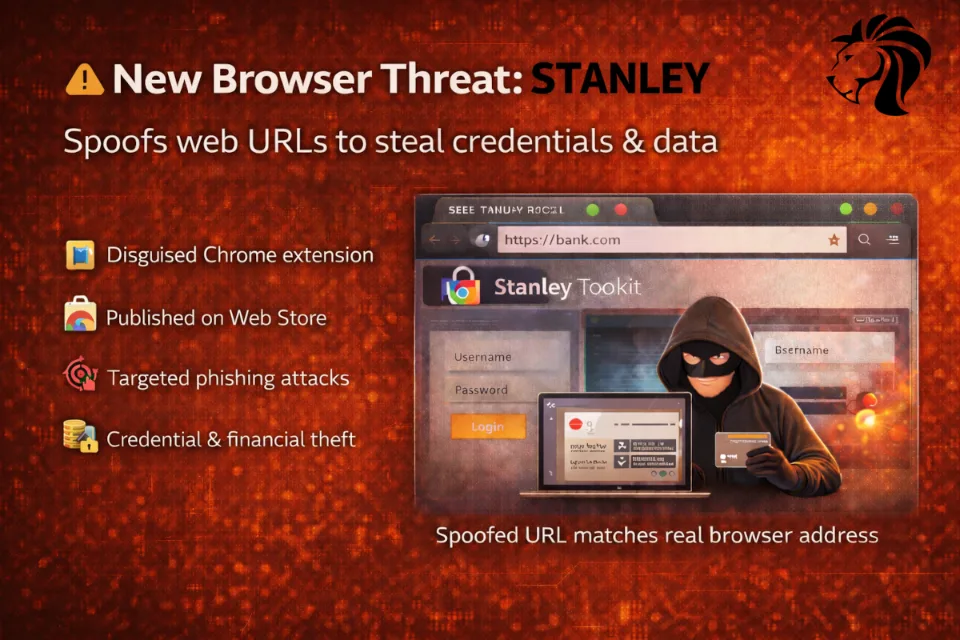
🔹 Website spoofing without URL changes
The victim sees a fake website, but the browser’s address bar continues to display the legitimate domain.
🔹 Chrome extension delivery
Disguised as a notes/bookmarks app (“Notely”), the malicious extension runs before page content loads.
🔹 Official distribution risk
The seller claims guaranteed publication on the Chrome Web Store, bypassing user suspicion.
🔹 Highly targeted attacks
Victims are tracked via IP addresses, enabling precision phishing and cross-device correlation.
🔹 Persistent command & control
📡 The extension phones home every 10 seconds
🔄 Uses backup domains to survive takedowns
🧠 Operators configure hijacking rules via a web panel
Thousands of users are already compromised, according to researchers.
What This Means for Organizations
🏢 Browser extensions are now a primary attack surface
🔐 Extension marketplaces approve once — updates can be malicious later
⚙️ Allow-listing and permission control are no longer optional
Key defensive actions:
✔ Enforce strict extension allow-listing
✔ Monitor extension updates, not just installs
✔ Limit permissions aggressively
✔ Educate users that “correct URL ≠ safe site”
Browser security can no longer rely solely on visual trust.