Modern phishing attacks aren’t just designed to trick employees — they’re increasingly designed to overwhelm security teams.
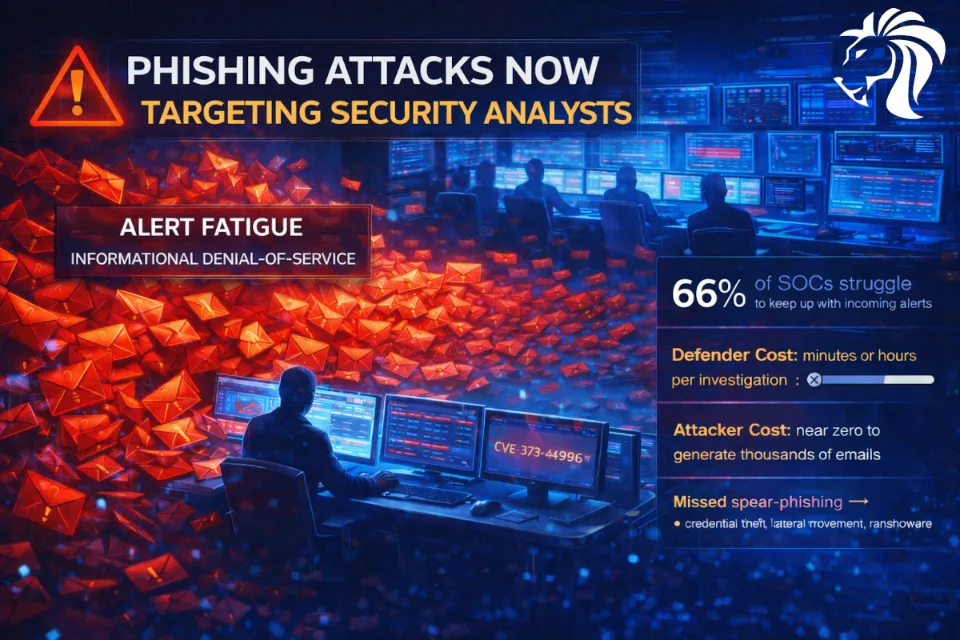
Attackers send large volumes of low-quality phishing emails to flood Security Operations Centers (SOCs) with alerts. Hidden within that noise are highly targeted spear-phishing emails aimed at critical personnel.
This tactic effectively creates an Informational Denial-of-Service (IDoS) against analysts.
Why this works
When report queues spike:
• Analysts triage faster
• Investigation depth drops
• Novel indicators are missed
• Real attacks blend into the noise
Research shows 66% of SOC teams struggle to keep up with incoming alerts, creating an opportunity that attackers actively exploit.
The asymmetry problem
• Attacker cost: near zero to generate thousands of phishing emails
• Defender cost: minutes or hours of analyst time per investigation
A single missed spear-phish can lead to credential theft, lateral movement, or ransomware deployment.
A new approach to phishing defense
Forward-leaning SOCs are shifting toward decision-ready AI investigations, where automated analysis provides:
• Verified sender authentication (SPF, DKIM, DMARC)
• Social engineering detection
• Endpoint telemetry correlation
• Transparent reasoning behind verdicts
This reduces investigation time from hours to minutes, preventing attackers from exploiting analyst overload.
Key takeaway
Phishing isn’t just a human-click problem anymore.
It’s also a SOC capacity problem.
Organizations that maintain consistent investigation quality under heavy alert volume remove one of the attacker’s most effective strategies.