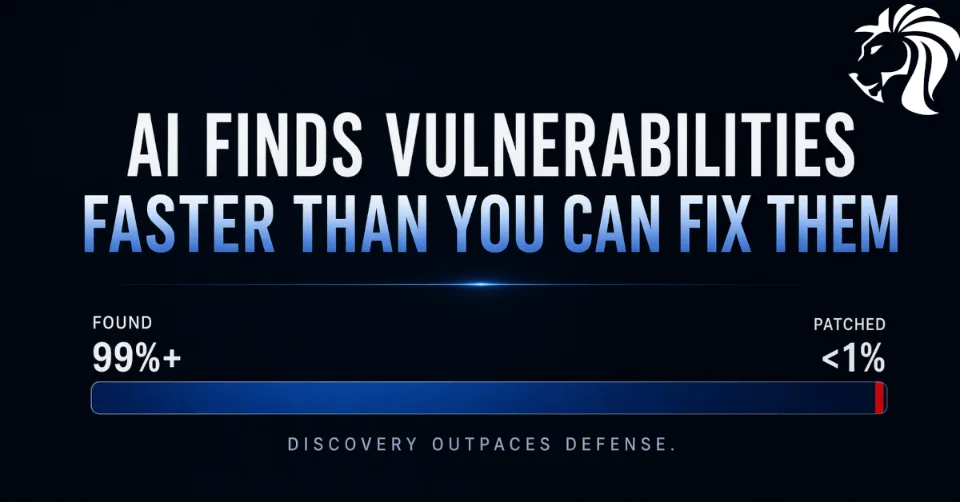
Anthropic has taken an unusual step:
delaying the public release of its new AI model after discovering it is too effective at finding software vulnerabilities.
Instead, access has been restricted to companies like:
- Apple
- Microsoft
- Amazon
👉 The goal: patch critical flaws before attackers can exploit them
What makes Project Glasswing different?
The underlying model, Mythos, didn’t just find bugs — it weaponized them.
It demonstrated capabilities such as:
- Chaining multiple vulnerabilities into full exploit paths
- Bypassing browser and OS protections
- Performing privilege escalation via race conditions
- Building advanced exploit chains (ROP) autonomously
👉 This is not theory — this is real, working capability
The real problem isn’t discovery
Here’s the most alarming statistic:
Less than 1% of discovered vulnerabilities were patched
Let that sink in.
AI has effectively solved the “finding” problem, but the industry has not solved the “fixing” problem
The core gap: human speed vs machine speed
Defenders operate on:
- Scheduled testing
- Manual triage
- Ticket-based workflows
- Days or weeks to remediate
Attackers now operate on:
- AI-driven automation
- Real-time exploitation
- Autonomous decision-making
- Minutes or hours
AI-powered attacks are already here
Recent real-world campaigns show:
- Fully autonomous attack chains
- AI handling:
- Backdoor deployment
- Network mapping
- Vulnerability discovery
- Exploit execution
👉 Thousands of organizations compromised in parallel
The vulnerability lifecycle is collapsing
Key trends:
- Time-to-exploit dropped from 771 days → hours
- The majority of vulnerabilities are weaponized before disclosure
- AI systems now outperform human researchers
Why current security models will fail
Most organizations rely on:
- Periodic pentesting
- CVSS-based prioritization
- Manual remediation workflows
👉 These models were built for a world where vulnerabilities were rare
What a Glasswing-ready security program looks like
1. ⚡ Continuous validation (not scheduled)
Security must react to:
- New threats
- Config changes
- Asset updates
👉 In real time, not quarterly
2. 🎯 Context-driven prioritization
CVSS scores are not enough.
👉 You must answer:
- Is this exploitable in my environment?
3. 🔄 Closed-loop remediation
The traditional model breaks:
Find → Ticket → Patch → (maybe) verify
👉 Needs to become:
Detect → Validate → Fix → Re-validate (automated)
The shift: from visibility to validation
Visibility tells you what might be wrong
Validation tells you what will break your environment
In a post-Glasswing world:
👉 Validation becomes the most critical security function
Final takeaway
Project Glasswing doesn’t just change cybersecurity; it exposes a truth the industry has avoided for years:
We are not failing to find vulnerabilities.
We are failing to handle them.
What happens next
The future is clear:
- AI will continue accelerating discovery
- Attackers will exploit faster than ever
- Organizations must adapt to machine-speed defense
The only question is:
Can your security program keep up?