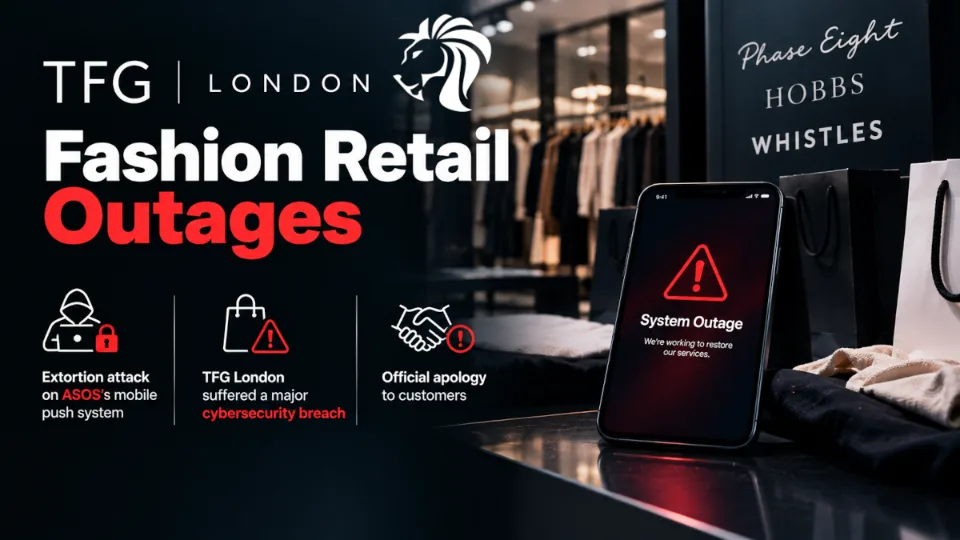
On Sunday 11 October 2026, TFG London — the UK arm of South African retail group The Foschini Group (TFG) — identified a cybersecurity incident affecting some of its IT systems. Three brands were hit: Phase Eight, Hobbs and Whistles.
The company apologised to customers, warned of delays to new orders, and said it was working with external cybersecurity specialists. By midweek, Whistles had paused online orders entirely.
Two clarifications matter before going further, because much of the coverage has blurred them:
This is an incident, not a confirmed data breach. TFG has said there is no reason to believe payment information is at risk, and no customer data theft has been confirmed. The visible damage is operational.
There is no established link to the ASOS attack. The Register stated the position plainly: "No evidence currently links the incidents at TFG London, ASOS, and H&M." Three fashion retailers had cyber trouble in roughly a week. That is a pattern of targeting, not a demonstrated campaign.
What makes this case useful is precisely that it is unglamorous. There is no ransom note, no leaked database, no named gang. A retailer is trying to keep selling clothes while some of its systems are offline, which is what most cyber incidents actually look like.
What happened
The disclosure
TFG said it became aware of the incident on Sunday 11 October. Its UK subsidiary bore the impact, with certain IT systems affected across the Phase Eight, Hobbs and Whistles brands. The company stated it was actively investigating alongside external cybersecurity specialists, had notified the relevant UK authorities, and apologised: "We apologise for any disruption."
What was not affected
This part is worth dwelling on, because it is the closest thing to good news in the story:
Affected | Not affected |
|---|---|
Phase Eight | White Stuff |
Hobbs | Inside Story |
Whistles | TFG Africa |
TFG Australia |
TFG's operations in Africa and Australia were untouched, as were two other brands in the same UK portfolio. For a group operating across the UK, Europe, America and Asia with more than 3,000 UK staff, containment to three brands within one subsidiary suggests the blast radius was limited — whether by design or by where the attacker happened to land.
The operational impact
The customer-facing consequences were specific and, in fairness to TFG, clearly communicated:
Orders placed before Sunday would be processed and delivered as normal.
Orders placed after Sunday might be delayed — with explicit instruction not to resubmit them, which heads off the duplicate-order chaos that usually follows an outage.
Stores remained open and trading.
In-store returns continued as usual, while the company worked on a solution for postal returns.
Several IT systems remained offline into the following week.
Whistles subsequently paused online orders altogether, while Phase Eight and Hobbs continued taking them.
That last development is the one to watch. A brand pausing e-commerce several days after the initial disclosure usually means either the investigation widened or recovery proved harder than first expected.
The wider week
TFG was the second UK retailer hit in a week, following the ASOS incident in which attackers reached the retailer's notification platform and pushed an extortion demand to customers' phones. Separately, H&M Group confirmed it was investigating claims circulating online about a potential incident involving a limited scope of its data, reportedly attributed to ShinyHunters — while stressing it had found no indication its systems were compromised.
Three different companies, three different pictures, no demonstrated connection. The temptation to draw one should be resisted until someone produces evidence.
How incidents like this unfold
TFG has not disclosed an attack vector, so what follows is about the shape of the response rather than the intrusion.
Detection on a Sunday. Weekend detection is common and awkward: skeleton staffing, slower escalation, and a decision window that runs into Monday trading. TFG disclosed publicly within about two days, which is reasonably brisk.
Containment by shutting things down. When the extent of access is unknown, the standard move is to take systems offline deliberately. Much of what customers experience as "the attack" is actually the defence — order processing paused because the company chose to pause it. This is usually the right call and is almost always reported as damage.
Partial service. Stores open, some brands taking orders, one brand paused, returns working in one channel but not the other. This patchwork is the signature of a company triaging system by system rather than pulling one big switch.
The communications problem. With no confirmed data theft, there is little to tell customers beyond "we are investigating." That silence is where customer anxiety — and opportunistic scams — tend to fill the gap.
Why it matters
Availability is the damage. Most retail cyber coverage focuses on stolen records. Here, the cost is unsold stock, delayed deliveries, suspended returns and staff time. For a fashion retailer, a paused e-commerce channel is lost revenue that does not come back.
The timing is the aggravating factor. NCC Group's Ade Clewlow made the point that retailers become especially attractive targets as Black Friday and the festive period approach. Peak trading is when systems are least tolerant of downtime, change freezes are in place, and the pressure to restore quickly is highest — which is precisely why attackers choose it.
Segmentation appears to have held. Africa and Australia unaffected, two sibling brands unaffected. Whether deliberate or fortunate, this is the single most valuable defensive observation in the case: the thing that limits a bad week to three brands instead of a whole group is architecture decided long beforehand.
Resilience is now the measurable thing. The NCSC's Jonathon Ellison framed it well — no organisation is immune, so the real test is how quickly a business detects, responds, recovers and keeps customers informed. On that scale, TFG's public communication has been clearer than most: specific about which brands, specific about which orders, specific about returns.
Sector clustering changes the risk calculation. Whether or not these three incidents are connected, fashion retail is visibly being probed. If you are in the sector, your peers' week is a reasonable forecast of your own.
Who is affected
Customers of Phase Eight, Hobbs and Whistles, facing delayed orders, a paused Whistles online channel and suspended postal returns.
TFG London's 3,000-plus UK staff, particularly store, customer service and logistics teams absorbing the disruption manually.
TFG Limited as a listed group (JSE: TFG), which must manage market disclosure alongside incident response.
UK fashion retail generally, now in its second week of sustained attention from attackers and media alike.
Suppliers and logistics partners dependent on TFG London's order flow.
What attackers can do with a retail outage
Even without stolen data, a visible incident creates opportunity:
Phishing that rides the disruption. "Your order was delayed — confirm your payment details" is a highly plausible message when orders genuinely are delayed. The NCSC's advice to customers was to stay vigilant about unexpected messages, and that is the reason.
Refund and compensation scams, aimed at customers who know something went wrong.
Fake customer service accounts on social platforms, intercepting complaints from frustrated shoppers.
Pressure for extortion, where disruption during peak trading is itself the leverage, regardless of whether data was taken.
Reconnaissance for later, as public disclosure reveals which systems a retailer depends on and how it responds.
What organisations should do
Architecture — the decisions that pay off during an incident
Segment by brand, region and business unit. TFG's Africa and Australia operations and two sibling brands came through untouched. Shared identity, shared networks and shared platforms are what turn one compromise into a group-wide event.
Separate e-commerce from corporate IT, so that an office-side compromise does not require you to stop selling.
Know which systems you can run degraded. TFG kept stores trading and in-store returns working. That is only possible if someone worked out in advance what can operate independently.
Peak-season readiness
Run your incident rehearsal before peak, not after it. Assume the attack lands in the worst week of your trading year, because that is when attackers prefer it.
Pre-agree who can authorise taking e-commerce offline. During an incident, that decision needs a named owner and a documented threshold, not a committee.
Build manual fallbacks for returns, refunds and order lookup. Postal returns were the gap here, and returns failures generate disproportionate customer anger.
Communications
Be specific about scope. Naming exactly which brands and which order dates are affected — as TFG did — prevents customers of unaffected brands from panicking and reduces support volume.
Tell customers what not to do. "Do not resubmit your order" is a small instruction that prevents duplicate charges, duplicate shipments and a second wave of complaints.
Say what you do not yet know, and commit to an update cadence. Silence is where scams and speculation grow.
Warn customers about phishing proactively, naming the channels you will and will not use to contact them.
Governance
Notify authorities early. TFG reported to UK authorities promptly. Where personal data may be involved, UK GDPR allows 72 hours from awareness, and an incomplete picture is not a reason to wait.
Resist premature attribution. No group has claimed TFG London, and linking it to unrelated incidents helps nobody. Attribution that turns out wrong damages credibility exactly when you need it.
For customers right now
Expect phishing referencing delayed orders. Go to the retailer's site or app directly rather than following links.
Do not resubmit orders placed after 11 October; check order status first.
Watch card statements for duplicate charges, which are a common side effect of outage-period ordering.
Final thoughts
There is no villain in this story yet — no gang, no ransom note, no leaked dataset. What there is instead is an unusually clear view of what a cyber incident costs a retailer when nothing is stolen at all: a paused website, suspended postal returns, thousands of staff working around broken systems, and customers who do not know what to think.
The lesson: for retail, resilience has overtaken confidentiality as the thing most likely to hurt you. The controls that mattered most here were decided long before the incident — how the group was segmented, whether stores could trade without head-office systems, whether anyone had thought about returns. Those are architecture and planning decisions, not security products.
The second lesson concerns restraint. Three fashion retailers had cyber trouble inside a week, and the pull toward a single grand narrative is strong. But H&M has confirmed no breach, no group has claimed TFG, and no evidence connects any of the three. Writing the campaign story now means rewriting it later.
Two questions worth asking before Black Friday: if your e-commerce platform went offline this Sunday, could your stores still trade — and does anyone own the decision to pull the plug?