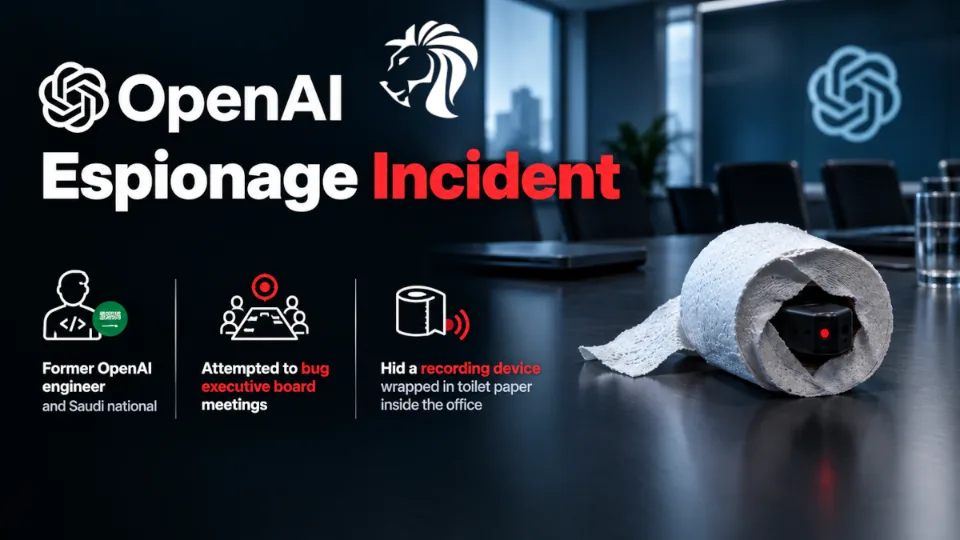
On 13 October 2026, the US Department of Justice announced the arrest of Abdulrahman Alfozan, 35, an engineer who had worked at OpenAI since July 2025. He was arrested on 9 October and charged with using, or endeavouring to use, a device to intercept oral communications.
The allegation: on or around 30 September, OpenAI personnel found a concealed audio recorder plugged into a USB port on the back of a television in an executive conference room at one of the company's San Francisco buildings. The device was wrapped in toilet paper.
Two details elevate this above an ordinary workplace incident. First, the complaint alleges he used an AI productivity tool at work to map out which rooms executives used and when. Second, OpenAI says it used its own AI models to identify who planted the device and trace its origins.
That symmetry — AI used for reconnaissance, AI used for attribution — is the part worth your attention.
Two framing corrections before we go further, because much of the coverage is loose on both:
Nobody has been charged with espionage. The charge is illegal interception of oral communications. No public allegation connects this to any foreign government, intelligence service or state programme. Alfozan's nationality has been reported by the DOJ and Reuters and is a matter of record, but nationality is not a motive and no state link has been alleged.
He was an employee at the time, not a former one. OpenAI terminated his employment after the discovery. "Former engineer" is accurate today and misleading about the moment the alleged conduct occurred, this was a current insider with legitimate access.
As with any criminal case, these are allegations, and Alfozan is presumed innocent unless proven guilty.
What happened
The discovery
OpenAI security staff found the device on 30 September 2026, during what has been reported as a routine check of the executive conference room. The DOJ describes it as a surreptitious audio recording device, inserted into a USB port behind a television in a restricted meeting room.
It was small — reported as thumb-sized — and concealed in toilet paper. Reporting suggests it had been in place for roughly two days before the sweep found it.
The investigation
OpenAI stated on X that it used its internal AI models to analyse the device and help identify who had placed it. The company referred the matter to the FBI, which continues to investigate.
Surveillance footage dated 5 October reportedly shows Alfozan checking the device behind the television — meaning he allegedly returned to it after it had already been discovered.
When security staff examined a bag, they reportedly found his wallet and identification alongside a second custom recording device similar to the first. OpenAI has said it had evidence he intended to place further devices in sensitive areas of its offices.
He was arrested on 9 October. His employment was terminated.
The AI reconnaissance trail
This is the element with the broadest lessons for other organisations.
According to the complaint, for about a month up to 28 September, Alfozan used a workplace AI productivity tool to make repeated enquiries about:
OpenAI's building addresses
Meeting rooms, their capacities and their calendars
Meetings involving external partners
The locations of leadership and executives
In other words: the reconnaissance that would once have required loitering in corridors, reading door signs and watching who walked where was allegedly conducted by asking an internal AI assistant, which answered helpfully because the employee was authorised to ask.
Separately, prosecutors say a ChatGPT account belonging to his wife was used to research how to build and conceal a recording device. The same account reportedly submitted prompts about the planted device specifically — including its custom header and unique MAC address — between 24 and 30 September. Using a household member's account rather than his own corporate account suggests an awareness that work accounts are logged.
How this kind of attack works
Physical access is still the shortest path
For all the attention paid to network intrusion, an employee with a badge can walk into a meeting room and plug something into a port. No firewall sees it. No endpoint agent runs on it. A USB port behind a wall-mounted television is unobserved by design; it is where the cables live, and nobody looks there.
The toilet paper is almost comic, but it works: a small white wad behind a TV reads as debris, not hardware.
AI assistants are a reconnaissance surface
The central insight here is new, and most organisations have not yet adjusted for it.
Enterprise AI assistants are connected to calendars, room booking systems, directories and internal documentation precisely so they can answer questions like "which room is the leadership meeting in?" That is the product working correctly. But it means an authorised insider can assemble a complete picture of executive movements — which rooms, which times, which external partners — in a handful of natural-language queries, without triggering anything.
Compare the traditional alternatives. Pulling an executive's calendar directly might generate an access-control event. Repeatedly browsing the room booking system might look odd. Asking an assistant looks like ordinary work, and in most deployments it is logged as a chat session rather than as a data access event — if it is reviewed at all.
Personal accounts to avoid the audit trail
Allegedly using a spouse's consumer ChatGPT account for the sensitive research is a recognisable pattern: keep incriminating activity off systems your employer can audit. It is also where the approach tends to fail, because consumer accounts are reachable by legal process and the queries about a specific device's MAC address allegedly tied the account to the hardware.
AI as the attribution tool
OpenAI says its own models helped identify the individual and trace the device's origins. The company has not detailed the method, and we should not over-read a statement made on X. But the direction is clear enough: the same capability that let an insider ask smart questions about a building also lets a security team ask smart questions about an incident.
Why it matters
The insider threat is back in physical form. Most insider-risk programmes are built around data exfiltration — downloads, USB copies, uploads to personal cloud. A recording device in a conference room sidesteps every one of those controls. What leaves the building is sound, not files.
AI tooling has quietly expanded what an insider can learn. An employee's effective knowledge of the organisation is no longer limited by what they can personally observe. It is limited by what the assistant will answer. For most companies, that is considerably more.
Boardroom conversations are a high-value target in their own right. In an AI company, an executive conference room may host discussions of model capabilities, release timing, partnerships and safety decisions — commercially sensitive, strategically sensitive, and valuable to a competitor, an investor or a journalist long before any state actor is involved.
Routine sweeps worked. The device was found during a check of the room. That is a genuinely encouraging detail, and it is a control most organisations do not have at all.
And a caution about narrative. The suspect's nationality has driven much of the coverage, and some of it has drifted toward implying state-sponsored espionage. No such allegation has been made publicly. Motive is unknown. Treating nationality as evidence of motive is both unfair and analytically useless — insider cases far more often involve money, grievance or personal entanglement than foreign intelligence services.
Who is affected
AI labs and research-heavy organisations, where a single overheard roadmap discussion carries disproportionate value.
Any organisation running an enterprise AI assistant connected to calendars, rooms and directories — which now includes most large employers.
Executive and board functions generally, whose meeting locations and schedules are often widely readable internally because they need to be bookable.
Facilities and physical security teams, who in many companies have no relationship with the information security function and are not part of insider-risk programmes.
Employees, who should understand that enterprise AI queries are company records and are, or should be, logged.
What organisations should do
Physical security of sensitive spaces
Sweep executive and board rooms on a schedule, not just before major meetings. This is what found the device at OpenAI.
Check the places nobody looks — behind wall-mounted displays, inside cable trays, under table edges, in power strips and dock stations.
Disable or physically block unused USB ports on conference room displays, video bars and room PCs. A port behind a TV serves almost no purpose and presents an easy socket for powering a device.
Control access to executive meeting rooms by badge, and review the access logs rather than merely collecting them.
Treat removable hardware found in sensitive rooms as an incident, preserving it for forensics instead of unplugging and binning it.
Govern the AI assistant as a data access path
Log and review enterprise AI queries as data access events, not as chat transcripts. The question "where do executives meet?" should be treated the same as opening the executive calendar.
Apply least privilege to what the assistant can answer. Executive calendars, room occupancy for restricted spaces and partner meeting details should not be generally retrievable by any authenticated employee.
Alert on reconnaissance-shaped query patterns — repeated enquiries about building layouts, executive locations, room capacities and schedules, especially from employees with no business reason to ask.
Redact sensitive attendee and partner information from room booking data exposed to the assistant.
Insider risk
Extend insider-risk programmes beyond data loss. Include physical reconnaissance, access-pattern anomalies and unusual interest in executive activity.
Join up facilities, HR and security. This case involved a badge, a meeting room, an HR record and an AI tool. In most organisations, those four live in four separate silos.
Remember that personal accounts are outside your visibility but not outside legal reach. You cannot monitor them; investigators can often obtain them. Design your internal controls accordingly rather than assuming total visibility.
Culture and fairness
Investigate behaviour, not identity. An insider-risk programme that weights nationality as a risk factor will generate false positives, damage trust, and in many jurisdictions create legal exposure. Behavioural indicators — reconnaissance queries, access anomalies, after-hours presence in restricted areas — are both fairer and more predictive.
Final thoughts
Strip this case to its mechanics and you have an old attack and a new one running side by side. The old attack is a recorder behind a television, concealed with toilet paper — the kind of thing that would have worked in 1975. The new one is allegedly asking an AI assistant where the executives meet, and getting a straight answer.
The lesson: enterprise AI assistants have become the fastest reconnaissance tool inside your own building, and almost nobody is monitoring them as such. They are connected to the calendar, the room system and the org chart because that is what makes them useful. An insider does not need to escalate privileges to exploit that — they need to ask.
The second lesson is more encouraging. The device was found during a routine check of the room, and OpenAI says its own AI models helped identify who placed it. Both the old control and the new one did their jobs. Most organisations have neither.
Two questions worth asking this week: when was your board room last swept, and if an employee spent a month asking your AI assistant where your executives meet, would anyone know?
A final word on tone. This is an allegation against one named individual who is entitled to the presumption of innocence, and the motive behind it is genuinely unknown. The security lessons stand on their own merits and do not require the more lurid framing some coverage has reached for.